Meyer Must Be Lifted — and the Art of Passing Blind
Two moves in Meyer behave differently from every other claim: announcing Meyer itself, and passing the cup without looking. Both are powerful and both are easy to misuse. This guide explains how MeyerLive3D handles them and how to use them well.
Why Meyer can only be lifted
Every claim must be beaten by the next one. Meyer (21) is the highest roll there is, so nothing can beat it. If the next player "believed" a Meyer, they would have to announce something higher — and there is nothing higher. The game would be stuck.
So the rule is simple: a claimed Meyer cannot be believed. The player who receives it has one option, and MeyerLive3D shows them one button.
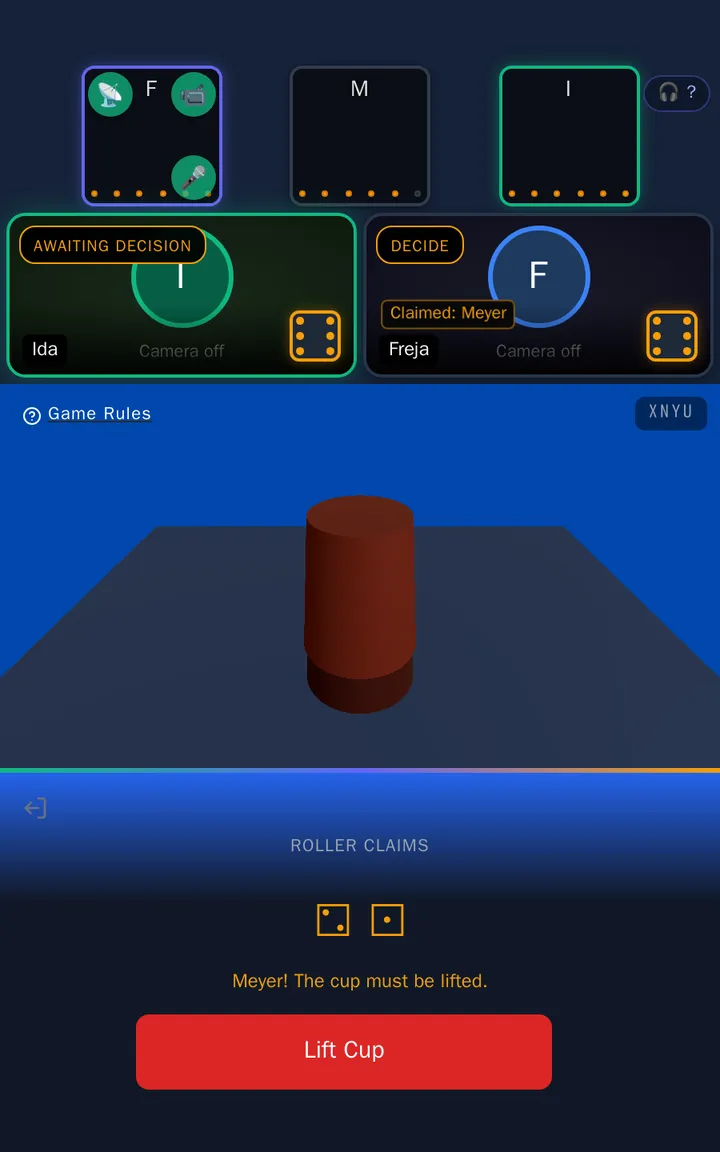
The same holds if the decider runs out of time. Normally a decider who does not act before the countdown ends is treated as having believed; for a Meyer claim the game lifts the cup instead.
The lift then settles it as usual: if the dice really are 21, the lifter loses a life; otherwise the claimer does.

When claiming Meyer makes sense
Because a Meyer claim is always lifted, it is a straight bet. If you really rolled Meyer, announcing it wins the round for certain: the next player must lift, and loses. If you did not, you will be caught for certain. A bluffed Meyer therefore only makes sense when every other claim open to you is almost as likely to be lifted — typically when the floor is already a high pair or Little Meyer.
In the game pictured above, the claimer held Little Meyer against a floor of 5-4. An honest Little Meyer could only have been beaten by a real Meyer; the Meyer bluff threw that away.
The certainty cuts the other way too: a true Meyer always wins, so a player who announces Meyer calmly may simply have it. It happens about once in every eighteen rolls.
Passing blind
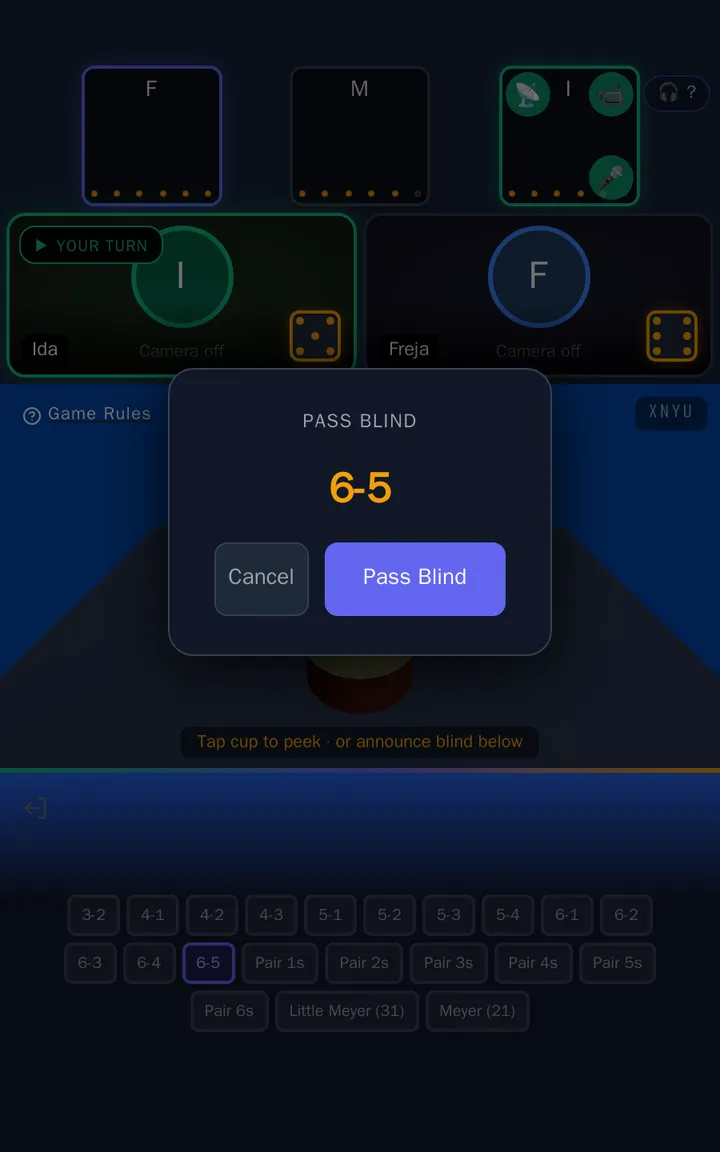
A blind pass means announcing a claim without peeking at your own dice. In MeyerLive3D, after rolling you can tap the cup to peek or choose Pass Blind, which opens the claim board at once.
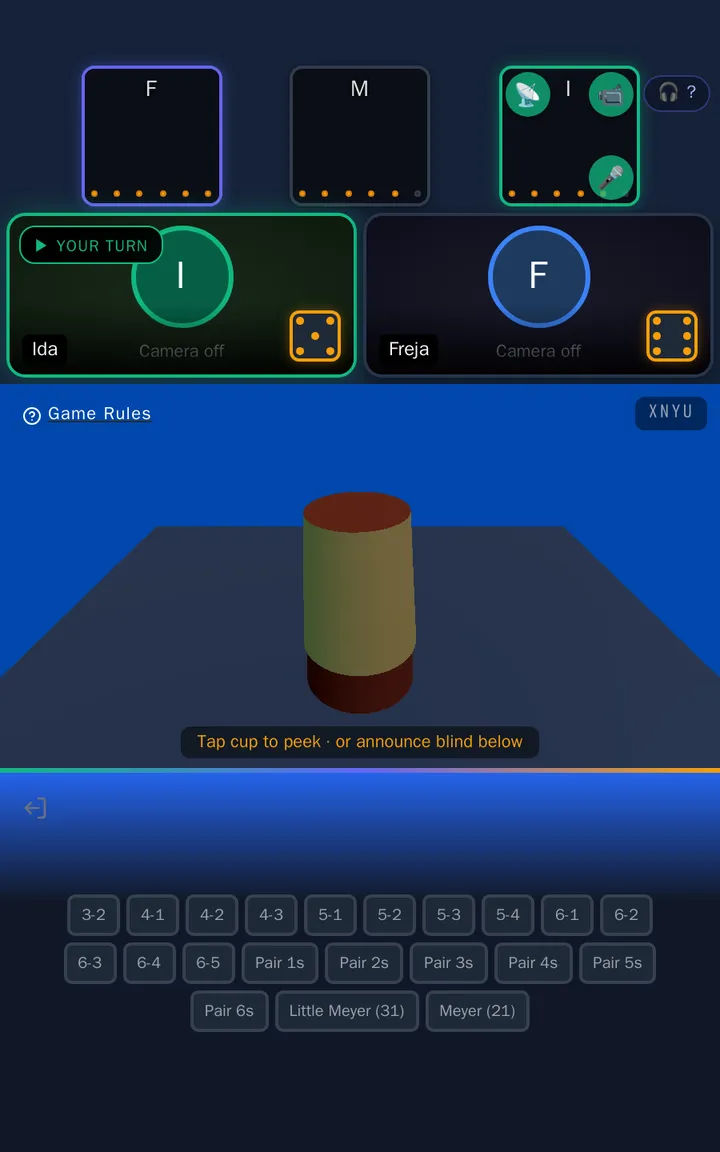
A blind claim follows the usual rule: it must strictly beat the claim before it. What changes is that you do not know whether you are telling the truth — and neither does anyone else. The next player sees the claim marked as blind.
Why anyone would pass blind
- It cannot be read. A blind claimer has no tell, because there is no secret to hide. Against players who read faces well, that is a real advantage.
- Low on the ladder, it is often true. A blind claim just above a low floor is honest more often than not.
- It shows confidence. The next player has to decide whether the dice agree with you.
The danger is just as plain: high up the ladder a blind claim is very likely false, and everybody knows it. Blind passing is a tool for the start of a round.
Summary
- A claimed Meyer must be lifted; the decider only gets the Lift Cup button.
- A true Meyer always wins the round; a bluffed Meyer always loses it.
- A blind claim must still beat the previous claim and is marked as blind.
- Pass blind early in a round; avoid it high up the ladder.