Believe or Lift? Making the Big Decision in Meyer
Every turn in Meyer that is not a roll is a decision: the claim in front of you is either true or it is not, and you have to choose whether to believe it or lift the cup. This guide is about making that choice well. It needs a little arithmetic, but mostly it needs attention.
What each choice really costs
It is tempting to think the question is simply "is this a lie?" It is not. The two options carry different risks:
- Lift, and the round ends at once. If the dice are at least as good as the claim, you lose a life; if not, the claimer does.
- Believe, and nothing is lost yet — but you take the cup, roll, and must announce something strictly higher. If your roll is not good enough, you are now the one who has to bluff, with the next player deciding about you.
So the better question is: which is more dangerous for me — this claim being true, or having to beat it?
The few numbers worth knowing
Two dice give 36 equally likely outcomes. Each pair comes up once in 36; every other roll, including Meyer and Little Meyer, comes up twice. That is all the maths in the game, and a few landmarks are enough:
- A fresh roll beats 6-1 exactly half the time.
- It beats 6-4 only a third of the time.
- It beats a pair of 1s only a quarter of the time.
- It beats a pair of 6s only 4 times in 36 — and those four are Little Meyer and Meyer.
- Meyer itself comes up 2 times in 36, about once every eighteen rolls.
Read them as a warning about believing. Once a claim reaches the doubles, believing it means you will usually have to bluff on top of it.
The board does part of the work
When you believe, MeyerLive3D's claim board only offers what beats the claim you accepted, and it shows where your own roll falls among them.
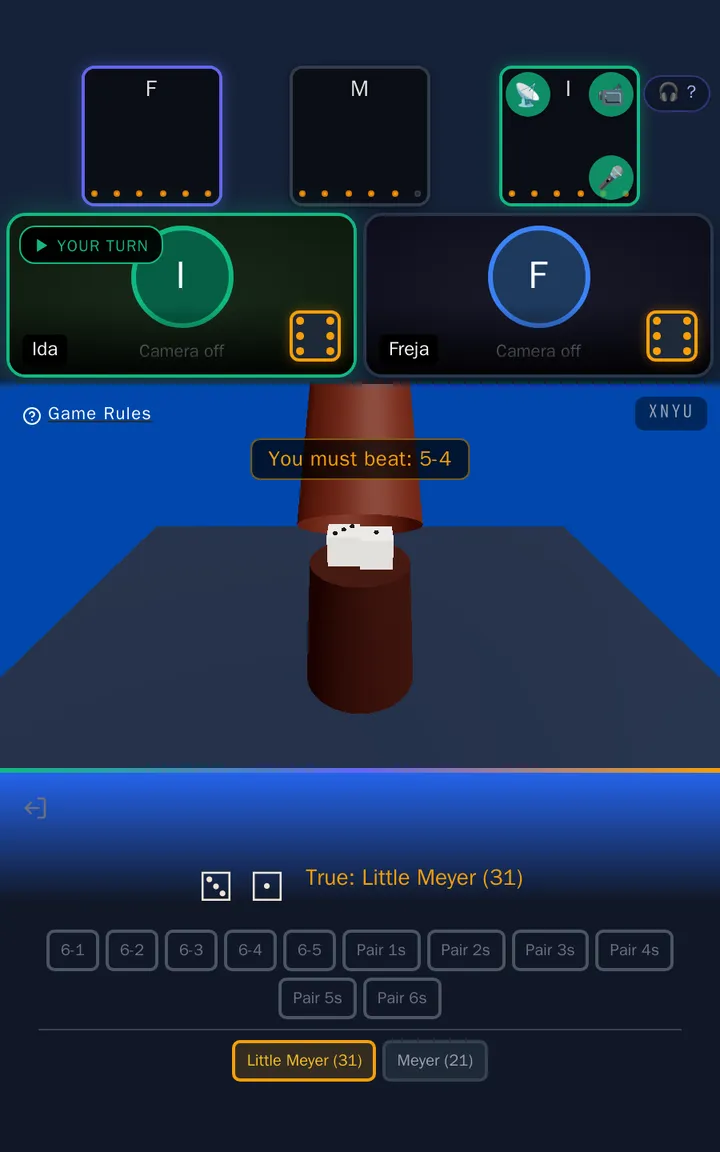
Here the believer rolled Little Meyer, so every claim up to Little Meyer is honest. That was lucky, but believing a mid-table claim like 5-4 works out more often than not: a fresh roll beats it 20 times in 36.
Questions that matter more than odds
- What did they have to beat? A claim that barely tops the previous one is the most natural lie. A player forced to beat 6-3 who announces 6-4 needed one of the better rolls in the game.
- How fast did they claim? An instant claim after the peek is usually confident. A long pause followed by a high number deserves a lift.
- What does this player usually do? Most people have a favourite bluff. Learn it.
- How many lives does everyone have? A player on their last life tends to gamble; a player who just lost one tends to play safe.

Two rules of thumb
- Low claims: believe more often. They are easy to beat, so believing costs little, and lifting an honest low claim is the cheapest way to lose a life.
- High claims: lift more often. Once a claim reaches the doubles, believing it usually means bluffing yourself. Unless the claimer has given you a reason to trust them, the cup is your friend.
And a claim of Meyer is not a decision at all: it must be lifted. Our guide to Meyer and blind passing explains why.