Meyer, Mäxchen and Mia: One Dice Game, Many Names
Ask around a Danish or Norwegian student hall and almost everyone knows Meyer. Cross the border to Germany and the same game is called Mäxchen; elsewhere you may hear Mia. It belongs to a large family of dice games built on one idea: you roll in secret, announce your result, and the others must decide whether to believe you.
A tavern game with obscure origins
Like most pub and parlour games, Meyer has no inventor and no founding date. It spread by being played rather than written down, which is why the rules — and even the name of the best roll — vary from town to town. The core never changes: two dice under a cup, a secret peek, a claim that must climb, and a lift to settle it. It needs almost no equipment, is learned in two minutes, and works for any number of players — ideal for a crowded table.
The names of the best roll
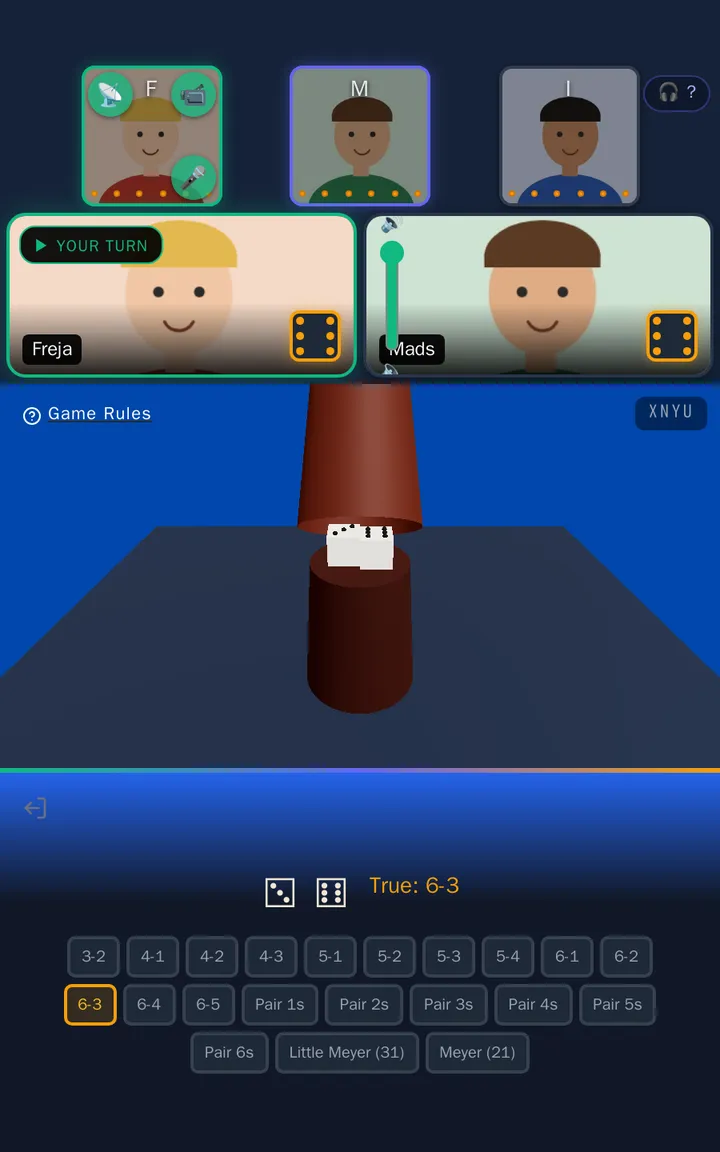
A 2 and a 1 is the top of the ladder almost everywhere, but it goes by different names. In Denmark and Norway it is Meyer, and the game is named after it; 31, the second-best roll, is Little Meyer (Danish: Lille Meyer). German players say Mäxchen or Mäxle for the game and often Mia for the top roll. Below those two rolls the ranking is usually the same: pairs above the ordinary rolls, and the ordinary rolls by value, read with the higher die first.
Relatives in the family
- Liar's Dice uses several dice per player and bets on how many of a face are on the table in total — the same secret-roll-and-claim heart, but claims about everyone's dice rather than one roll.
- Perudo (or Dudo) is the South American branch of Liar's Dice, played with five dice each under cups.
- Poker dice games share the idea of ranked combinations, usually without the bluff and the lift.
What sets Meyer apart is speed. A round takes seconds, and with only two dice the chances are simple enough to learn by heart.
House rules you may meet
- Blind passing. A player may pass without peeking. Tables differ on what a blind claim must say; some allow it to repeat the previous claim. MeyerLive3D supports blind passing with the usual ladder rule: a blind claim must still beat the previous one (see passing blind).
- Double penalty for Meyer. If a lifted cup shows a genuine Meyer, the lifter loses two lives instead of one.
- Roll-off starts. Instead of choosing a first player, everyone rolls openly and the lowest roll starts.
- Stakes. At real tables the loser of a game often buys the next round. Online, agree on your own forfeit.
MeyerLive3D plays the classic rules on our Game Rules page: six lives each, a ladder that must strictly climb, a Meyer that must be lifted, and the loser of each round starting the next. Every table plays the same game, and the traditions are left to the group.
From kitchen tables to browser tables
Meyer depends on watching each other: the pause before a claim, a smile that comes too quickly. An online version only works if it keeps the faces. MeyerLive3D puts every player's camera around a shared 3D table, rolls the dice on the server so nobody can cheat, and shows each roll only to the player who rolled it — the same promises a real cup makes.