Bluffing in Meyer: When to Lie and How
The rules of Meyer fit on a postcard. What keeps Danes and Norwegians playing it for a lifetime is the part the rules leave out: deciding what to say. This guide collects the ideas experienced players use when they hold the cup, illustrated with moments from real MeyerLive3D games.
1. The truth is a weapon too
New players think of a claim as a choice between "the truth" and "a lie". It is more useful to see it as a choice of number, where the truth is only a boundary. Any claim at or below your real roll is safe if the cup is lifted; anything above it is a bluff. Within the safe range, pick the number that does the most damage.
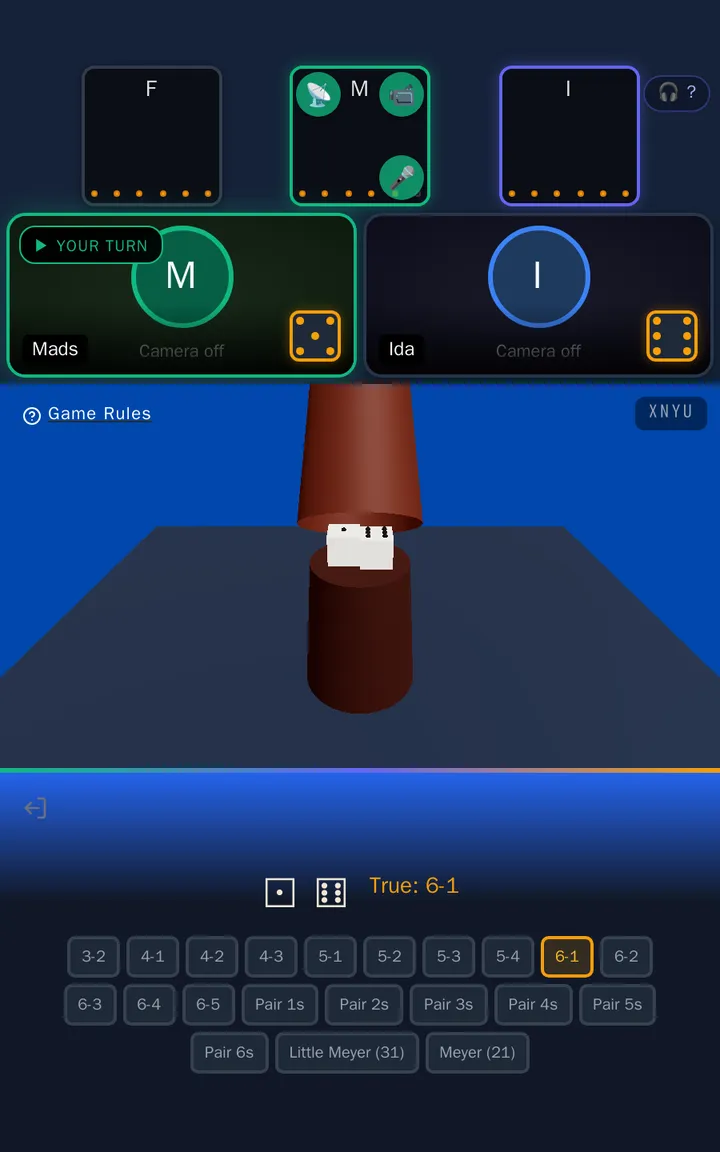
The 6-1 above was announced as a plain 5-4. Nobody lifts a modest 5-4 lightly, and if they do, they lose, because the dice are better than the claim. Strong rolls make the best quiet claims.
2. Choosing a lie
Sooner or later you peek at a roll that cannot beat the floor, and you must bluff. The question is how far.
- Claim just above the floor. The smallest legal step is the most believable and leaves the next player the most room to keep going.
- Avoid the obvious panic claims. When the floor is 6-5, a pair of 1s is the smallest legal claim — and therefore the most common lie at that point. Experienced players know it.
- Remember the size of your lie barely matters if you are lifted. A small bluff is caught just as surely as a big one.

3. Don't bluff when you don't have to
It sounds obvious, yet it is the most common mistake at the table. If your roll beats the floor, an honest claim passes all the pressure to the next player. Bluffing higher than necessary only adds risk. The classic case is reaching for Meyer while holding Little Meyer — see our round-by-round game for exactly that mistake.
4. Reading and being read
In a kitchen-table game you watch hands and eyes; in MeyerLive3D you watch the camera tiles, the time a player takes between peek and claim, and their habits over the evening. The same applies to you:
- Keep your rhythm. Take roughly the same time over every claim, honest or not.
- Vary your favourite lie. Players notice which number you reach for under pressure.
- Consider passing blind. If you do not know your roll, you cannot give it away (see passing blind).
5. Play the table, not only the next player
With three or more players, your claim shapes the whole round. Pushing the claim up quickly can leave a player two seats away in an impossible spot. With many players the ladder climbs fast and late claims are usually bluffs; with two, every turn is a duel and patience pays.
6. Keep it friendly
A good bluff is part of the fun for everyone, including the player who fell for it. Meyer is at its best as a social game: tease, laugh, and remember that the dice decide about half of every evening. The other half is your poker face — which is why MeyerLive3D puts every player's camera around the table, for those who want to switch it on.